Discover how AI Chatbots powered by RAG technology help enterprises optimize internal information retrieval processes, save time, and boost productivity with accurate 24/7 responses
No table of contents available for this article
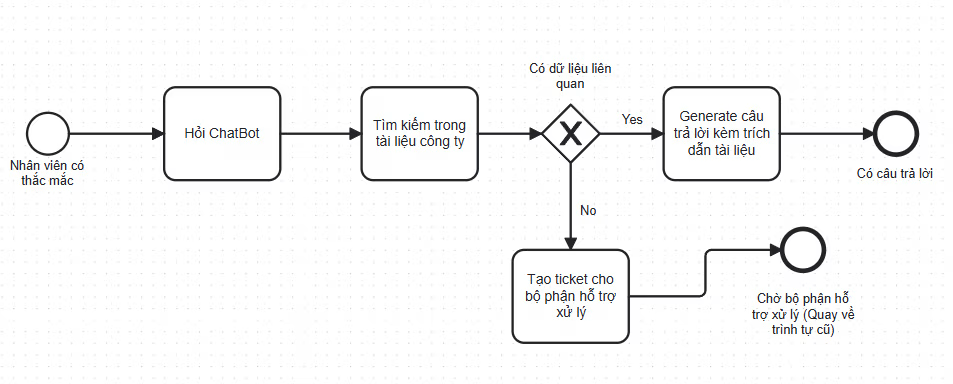
In modern business environments, a familiar scenario often unfolds: when employees need to find information about work processes, company policies, or internal software guidelines, they spend dozens of minutes – sometimes hours – digging through documents, scrolling through old emails, or messaging colleagues for answers.
This not only disrupts workflow but also puts pressure on support departments like HR, administration, and IT. Worse, the answers received are sometimes inconsistent or outdated – directly impacting productivity and work quality.
The solution? AI Chatbot combined with RAG (Retrieval-Augmented Generation) technology – a technological trend that's transforming how enterprises manage and share internal knowledge.
Unlike traditional retrieval processes with multiple intermediary steps, AI chatbots offer superior advantages:
Instant 24/7 Responses: Employees simply ask a question and receive an answer within seconds, without waiting or depending on support department working hours.
Deep Contextual Understanding: Unlike conventional search tools that rely solely on keywords, modern AI chatbots can understand the true intent behind questions. For example, "How do I request time off?" is understood as a query about the leave application process, not just a search for the term "time off".
Accurate Retrieval: The system automatically searches information from internal document repositories and provides clear source citations, ensuring reliability.
Acknowledges Limitations: When relevant information isn't found, the chatbot honestly informs users instead of "making things up" – avoiding the "hallucination" phenomenon (AI generating false content).
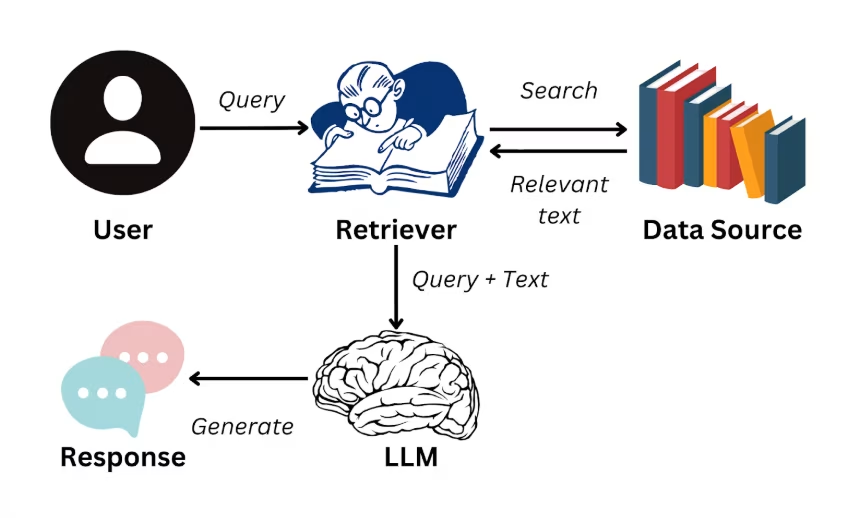
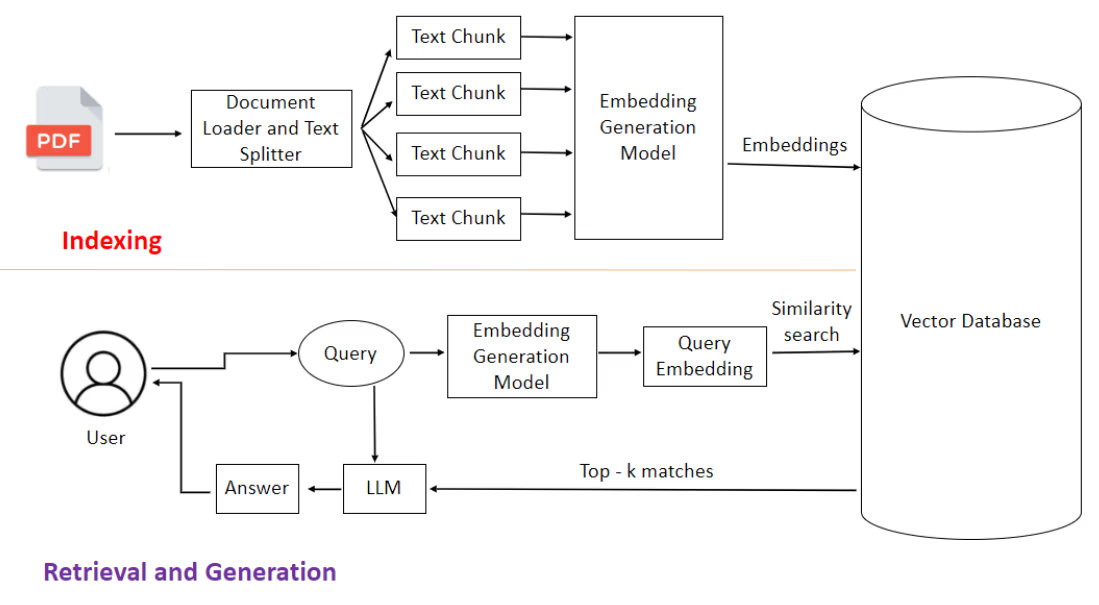
RAG (Retrieval-Augmented Generation) is a technology that combines information retrieval with natural text generation. The system operates through 4 main steps:
Step 1: Document Preprocessing and Vectorization
Before the chatbot can operate, all internal documents need preparation:
Data Cleaning: Remove redundant characters and unnecessary formatting (HTML tags, broken tables...) to ensure input quality.
Intelligent Chunking: Documents are divided into small chunks of approximately 100-1000 words. Each chunk must maintain full context – for example, a 5-step process is kept intact within one chunk rather than being fragmented.
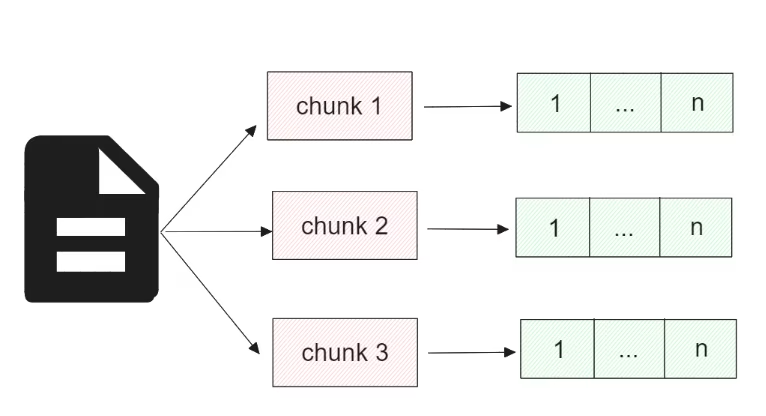
Content Vectorization: Using language embedding models (Sentence-BERT, OpenAI Embeddings, or multilingual-e5) to convert each text chunk into a numerical vector in high-dimensional space (typically 384-1536 dimensions). This vector is a "numerical fingerprint" that helps computers understand the semantic meaning of text.
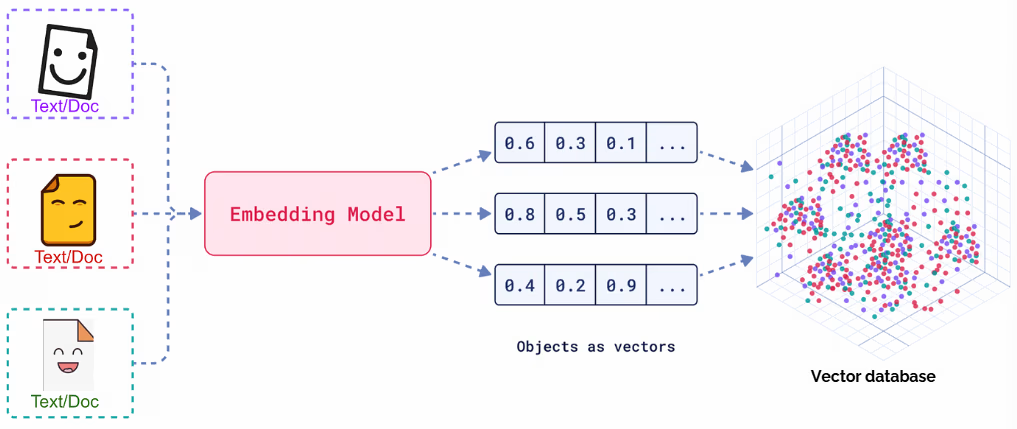
The result is a digitized knowledge database – the foundation for the chatbot to "understand" enterprise knowledge.
Step 2: User Query Vectorization
When an employee asks a question:
The system performs natural language processing (NLP) to identify the intent and content of the question.
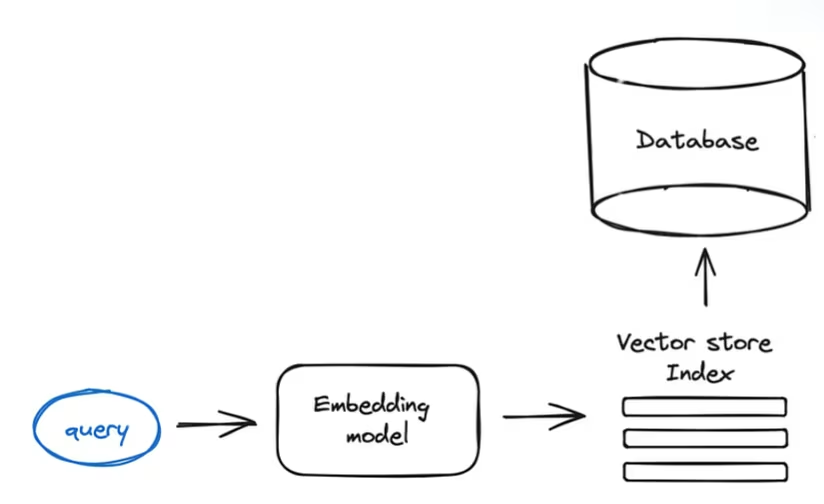
The question is converted into a vector using the same model used for documents, ensuring both use the same "numerical language" for comparison.
Step 3: Semantic Search
This is the "Retrieval" step – the heart of RAG:
The system compares the query vector with all document vectors using algorithms like cosine similarity or FAISS (Facebook AI Similarity Search).
The top 3-10 text chunks with the highest similarity scores are selected as the "background context" for the answer.
For example: The question "How do I request a salary increase?" will retrieve sections about performance evaluation processes, salary review cycles, and salary increase request forms – even though no section contains the exact phrase "request a salary increase".
Step 4: Natural Answer Generation
The relevant text chunks combined with the original question are fed into a Large Language Model (LLM like GPT-4, Claude, or LLaMA) to:
Synthesize information coherently and understandably
Rephrase in a natural conversational style
Provide clear source citations to ensure transparency
If information is insufficient, the chatbot will respond: "I couldn't find information about this in the documents. You can contact the HR department for more specific support."
Significant Time Savings: Instead of spending 15-30 minutes searching, employees receive answers in 5-10 seconds. With 100 employees each saving 20 minutes daily, the enterprise gains 33 additional productive hours every day.
Reduced Support Department Load: Chatbots handle 60-80% of common questions, allowing HR and IT to focus on more complex issues.
Ensures Consistency: All employees receive standardized, accurate information from official document sources, avoiding misunderstandings from word-of-mouth communication.
Flexible Integration: Easy connection with existing ERP, CRM, SharePoint, Notion, or internal wiki systems.
Continuous Learning and Improvement: The system records unanswered questions, helping enterprises supplement documentation and improve knowledge quality.
Implementing AI chatbots with RAG isn't without challenges:
Input Data Quality: Documents must be standardized, clearly structured, and regularly updated. The principle "garbage in, garbage out" still applies – poor data yields poor results.
Technical Infrastructure: Requires vector databases (like Pinecone, Weaviate, or Milvus) to handle fast searches across millions of vectors. For large enterprises, hosting and processing costs can be significant.
Implementation Timeline: Integration with existing systems, employee training, and model fine-tuning typically takes 2-6 months depending on scale.
Information Security: Need to establish strict access controls – not all employees should access all types of documents.
However, with a reasonable deployment strategy and long-term commitment, this is an investment with clear ROI – making operational processes smoother and more professional.
AI Chatbots with RAG technology aren't just simple Q&A tools. They represent a significant step forward in digital transformation, helping enterprises build an intelligent knowledge ecosystem – where information is shared quickly, accurately, and fairly with all members.
If you work in operations, human resources management, or information technology, this is a solution worth serious consideration. Digital transformation isn't about the future – it's happening right now, and AI chatbots could be the strategic ally your enterprise is seeking.
References:
Lewis, P., et al. (2020). "Retrieval-Augmented Generation for Knowledge-Intensive NLP Tasks". arXiv:2005.11401
OpenAI Documentation on Embeddings and Vector Search
FAISS (Facebook AI Similarity Search) Documentation - Meta AI Research
Sentence-BERT: Sentence Embeddings using Siamese BERT-Networks
